Pike a W Et Al ââåuseries Dating of Paleolithic Art in 11 Caves in Spainã¢ââ
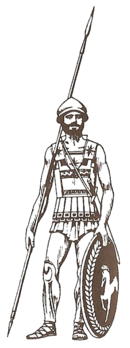
A spear is a pole weapon consisting of a shaft, usually of wood, with a pointed head. The head may exist simply the sharpened finish of the shaft itself, equally is the example with burn hardened spears, or it may be made of a more durable material fastened to the shaft, such as bone, flint, obsidian, iron, steel, or bronze. The near common design for hunting or combat spears since aboriginal times has incorporated a metallic spearhead shaped like a triangle, lozenge, or foliage. The heads of line-fishing spears usually feature barbs or serrated edges.
The word spear comes from the Old English spere, from the Proto-Germanic speri, from a Proto-Indo-European root *sper- "spear, pole". Spears tin exist divided into ii broad categories: those designed for thrusting as a melee weapon and those designed for throwing as a ranged weapon (commonly referred to every bit javelins or darts).
The spear has been used throughout human history both as a hunting and fishing tool and as a weapon. Along with the gild, knife, and axe, it is i of the primeval and near of import tools developed by early humans. As a weapon, information technology may be wielded with either one or ii easily. It was used in virtually every conflict upwardly until the modern era, where even so information technology continues on in the form of the stock-still bayonet on a long gun, and is probably the most commonly used weapon in history.[ane]
Origins [edit]
Spear manufacture and use is non bars to humans. It is also practiced past the western chimpanzee. Chimpanzees near Kédougou, Senegal have been observed to create spears by breaking straight limbs off trees, stripping them of their bawl and side branches, and sharpening one end with their teeth. They and then used the weapons to hunt galagos sleeping in hollows.[2]
Prehistory [edit]
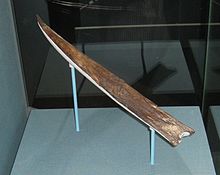

Archaeological evidence institute in present-day Germany documents that wooden spears have been used for hunting since at least 400,000 years ago,[3] and a 2012 study from the site of Kathu Pan in Southward Africa suggests that hominids, maybe Homo heidelbergensis, may accept adult the engineering of hafted stone-tipped spears in Africa about 500,000 years agone.[iv] [5] Forest does not preserve well, notwithstanding, and Craig Stanford, a primatologist and professor of anthropology at the University of Southern California, has suggested that the discovery of spear use by chimpanzees means that early humans may have used wooden spears before this.[6]
Neanderthals were constructing stone spear heads from every bit early as 300,000 BP, and past 250,000 years agone, wooden spears were fabricated with fire-hardened points.
From circa 200,000 BCE onwards, Heart Paleolithic humans began to brand complex stone blades with flaked edges which were used equally spear heads. These rock heads could exist stock-still to the spear shaft by glue or resin or by bindings fabricated of creature sinew, leather strips or vegetable matter. During this period, a clear difference remained between spears designed to exist thrown and those designed to exist used in mitt-to-hand combat. By the Magdalenian flow (c. 15,000–9500 BCE), spear-throwers similar to the later atlatl were in use.[seven]
Military [edit]

Europe [edit]
Classical antiquity [edit]
Aboriginal Greeks [edit]
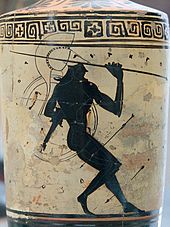
Athenian warrior wielding a spear in battle
The spear is the principal weapon of the warriors of Homer's Iliad. The employ of both a single thrusting spear and two throwing spears are mentioned. It has been suggested that two styles of combat are being described; an early on style, with thrusting spears, dating to the Mycenaean menstruation in which the Iliad is set, and, anachronistically, a later style, with throwing spears, from Homer'due south own Archaic period.[8]
In the 7th century BCE, the Greeks evolved a new close-lodge infantry germination, the phalanx.[9] The primal to this formation was the hoplite, who was equipped with a large, circular, statuary-faced shield (aspis) and a 7–9 ft (2.i–2.7 thou) spear with an iron caput and bronze barrel-spike (doru).[10] The hoplite phalanx dominated warfare amongst the Greek City States from the seventh into the 4th century BCE.
The 4th century saw major changes. One was the greater utilise of peltasts, lite infantry armed with spear and javelins.[xi] The other was the development of the sarissa, a two-handed pike 18 ft (5.5 m) in length, past the Macedonians under Phillip of Macedon and Alexander the Cracking.[12] The expressway phalanx, supported by peltasts and cavalry, became the ascendant mode of warfare among the Greeks from the late 4th century onward[13] until Greek military systems were supplanted by the Roman legions.
Ancient Romans [edit]

Re-enactor outfitted as a Late Roman legionary conveying a pilum
In the pre-Marian Roman armies, the first two lines of battle, the hastati and principes, often fought with a sword called a gladius and pila, heavy javelins that were specifically designed to be thrown at an enemy to pierce and foul a target's shield. Originally the principes were armed with a short spear called a hasta, but these gradually cruel out of apply, eventually being replaced by the gladius. The third line, the triarii, connected to employ the hasta.
From the tardily 2nd century BCE, all legionaries were equipped with the pilum. The pilum continued to be the standard legionary spear until the terminate of the 2nd century CE. Auxilia, however, were equipped with a simple hasta and, perchance, javelins or darts. During the 3rd century CE, although the pilum continued to be used, legionaries usually were equipped with other forms of throwing and thrusting spear, similar to auxilia of the previous century. By the 4th century, the pilum had effectively disappeared from common use.[14]
In the late menses of the Roman Empire, the spear became more often used because of its anti-cavalry capacities as the barbarian invasions were frequently conducted by people with a developed civilisation of cavalry in warfare.
Medieval flow [edit]
Afterwards the fall of the Western Roman Empire, the spear and shield continued to exist used by nearly all Western European cultures. Since a medieval spear required only a modest amount of steel along the sharpened edges (most of the spear-tip was wrought iron), information technology was an economical weapon. Quick to manufacture, and needing less smithing skill than a sword, information technology remained the main weapon of the common soldier. The Vikings, for instance, although often portrayed with axe or sword in mitt, were armed mostly with spears,[15] every bit were their Anglo-Saxon, Irish gaelic, or continental contemporaries.
Infantry [edit]

Assyrian soldier holding a spear and wearing a helmet. Item of a basalt relief from the palace of Tiglath-pileser III at Hadatu, Syrian arab republic. 744–727 BCE. Ancient Orient Museum, Istanbul
Broadly speaking, spears were either designed to be used in melee, or to exist thrown. Within this simple classification, there was a remarkable range of types. For example, Thousand. J. Swanton identified thirty different spearhead categories and sub-categories in early Saxon England.[16] Near medieval spearheads were mostly leaf-shaped. Notable types of early medieval spears include the angon, a throwing spear with a long caput similar to the Roman pilum, used past the Franks and Anglo-Saxons, and the winged (or lugged) spear, which had two prominent wings at the base of the spearhead, either to forbid the spear penetrating also far into an enemy or to help in spear fencing.[17] Originally a Frankish weapon, the winged spear also was popular with the Vikings. It would become the ancestor of later medieval polearms, such every bit the partisan and spetum.
The thrusting spear also has the advantage of reach, being considerably longer than other weapon types. Exact spear lengths are difficult to deduce as few spear shafts survive archaeologically but six–8 ft (1.eight–2.4 k) would seem to have been the norm. Some nations were noted for their long spears, including the Scots and the Flemish. Spears usually were used in tightly ordered formations, such as the shield wall or the schiltron. To resist cavalry, spear shafts could be planted confronting the basis.[18] William Wallace drew up his schiltrons in a circle at the Battle of Falkirk in 1298 to deter charging cavalry;[19] this was a widespread tactic sometimes known as the "crown" formation.[20] Thomas Randolph, 1st Earl of Moray used a circular schiltron on the beginning day of the Battle of Bannockburn. Even so, the rectangular schiltron was much more common and was used past King Robert the Bruce on the second day of the Battle of Bannockburn and in the Battle of Old Byland when he defeated English language armies.[21]
Throwing spears became rarer as the Centre Ages drew on, but survived in the hands of specialists such every bit the Catalan Almogavars.[22] They were commonly used in Ireland until the end of the 16th century.[23]
Spears began to lose manner amongst the infantry during the 14th century, being replaced by pole weapons that combined the thrusting properties of the spear with the cutting properties of the axe, such as the halberd. Where spears were retained they grew in length, eventually evolving into pikes, which would be a dominant infantry weapon in the 16th and 17th centuries.[24]
Cavalry [edit]
Cavalry spears were originally the same as infantry spears and were often used with two hands or held with ane paw overhead. In the twelfth century, subsequently the adoption of stirrups and a high-cantled saddle, the spear became a decidedly more powerful weapon. A mounted knight would secure the lance by property information technology with i hand and tucking it under the armpit (the couched lance technique)[25] This allowed all the momentum of the horse and knight to be focused on the weapon's tip, whilst still retaining accurateness and control. This employ of the spear spurred the evolution of the lance equally a distinct weapon that was perfected in the medieval sport of jousting.[26]
In the 14th century, tactical developments meant that knights and men-at-arms often fought on foot. This led to the practice of shortening the lance to about v ft (1.v m).) to make information technology more manageable.[27] Every bit dismounting became commonplace, specialist pole weapons such equally the pollaxe were adopted by knights and this practice ceased.[28]
Introduction of gunpowder [edit]
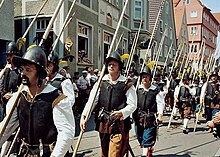
German reenactors of pikemen
The development of both the long, two-handed throughway and gunpowder firearms in Renaissance Europe saw an ever-increasing focus on integrated infantry tactics.[29] Those infantry not armed with these weapons carried variations on the pole-arm, including the halberd and the pecker. At the start of the Renaissance, cavalry remained predominantly lance-armed; gendarmes with the heavy knightly lance and lighter cavalry with a variety of lighter lances. By the 1540s, withal, pistol-armed cavalry chosen reiters were start to make their mark. Cavalry armed with pistols and other lighter firearms, along with a sword, had virtually replaced lance armed cavalry in Western Europe by the beginning of the 17th century.[thirty]
Ultimately, the spear proper was rendered obsolete on the battlefield. Its terminal flowering was the half-expressway or spontoon,[31] a shortened version of the pike carried by officers of diverse ranks. While originally a weapon, this came to be seen more equally a bluecoat of office, or leading staff by which troops were directed.[32] The one-half-pike, sometimes known every bit a boarding pike, was besides used as a weapon on lath ships until the late 19th century.[33]
Modern era [edit]
In conflicts such every bit the 2020–2022 Red china–India skirmishes, where firearms are prohibited, spears continue to come across military use.[ citation needed ]
Heart East [edit]
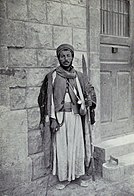
A Palestine Arab sufi ascetic carrying a short assegai in 1913.

Muslim warriors used a spear that was called an az-zaġāyah. Berbers pronounced information technology zaġāya, but the English term, derived from the One-time French via Berber, is "assegai". It is a pole weapon used for throwing or hurling, usually a low-cal spear or javelin fabricated of hard forest and pointed with a forged fe tip. The az-zaġāyah played an important role during the Islamic conquest likewise as during later periods, well into the 20th century. A longer pole az-zaġāyah was being used equally a hunting weapon from horseback. The az-zaġāyah was widely used. It existed in diverse forms in areas stretching from Southern Africa to the Indian subcontinent, although these places already had their ain variants of the spear. This javelin was the weapon of pick during the Fulani jihad likewise as during the Mahdist War in Sudan. It is still being used by certain wandering Sufi ascetics (Derwishes).
Asia [edit]

Chinese [edit]
In the Chinese martial arts, the Chinese spear (Qiang 槍) is popularly known as the "king of weapons". The spear is listed in the grouping of the four major weapons (forth with the gun (staff), dao (a unmarried-edged blade like to a sabre), and the jian (sword)).[34]
Spears were used first as hunting weapons amongst the ancient Chinese. They became popular as infantry weapons during the Warring States and Qin era, when spearmen were used as especially highly disciplined soldiers in organized group attacks. When used in germination fighting, spearmen would line upwardly their big rectangular or round shields in a shieldwall manner. The Qin also employed long spears (more akin to a pike) in formations similar to Swiss pikemen in gild to ward off cavalry. The Han Empire would use like tactics as its Qin predecessors. Halberds, polearms, and dagger axes were also common weapons during this time.
Spears were also common weaponry for Warring States, Qin, and Han era cavalry units. During these eras, the spear would develop into a longer lance-similar weapon used for cavalry charges.
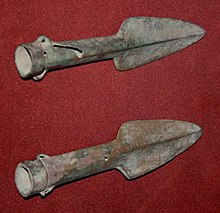
There are many words in Chinese that would be classified equally a spear in English language. The Mao is the predecessor of the Qiang. The first bronze Mao appeared in the Shang dynasty. This weapon was less prominent on the battlefield than the ge (dagger-axe). In some archaeological examples ii tiny holes or ears tin can exist found in the bract of the spearhead nigh the socket, these holes were presumably used to attach tassels, much similar modern day wushu spears.

A bronze spear, detect the ears on the side of the socket.

In the early Shang, the Mao appeared to have a relatively brusk shaft as well as a relatively narrow shaft every bit opposed to Mao in the later Shang and Western Zhou menses. Some Mao from this era are heavily decorated every bit is evidenced past a Warring States period Mao from the Ba Shu area.[35]
In the Han dynasty the Mao and the Ji (戟 Ji tin exist loosely defined every bit a halberd) rose to prominence in the armed forces. Interesting to notation is that the amount of fe Mao-heads found exceeds the number of bronze heads. By the terminate of the Han dynasty (Eastern Han) the process of replacement of the iron Mao had been completed and the bronze Mao had been rendered completely obsolete. Later on the Han dynasty toward the Sui and Tang dynasties the Mao used past cavalry were fitted with much longer shafts, as is mentioned in a higher place. During this era, the use of the Shuo (矟) was widespread among the footmen. The Shuo tin can be likened to a pike or simply a long spear.[36]
After the Tang dynasty, the popularity of the Mao declined and was replaced past the Qiang (枪). The Tang dynasty divided the Qiang in four categories: "一曰漆枪, 二曰木枪, 三曰白杆枪, 四曰扑头枪。" Roughly translated the four categories are: Qi (a kind of woods) Spears, Wooden Spears, Bai Gan (A kind of wood) Spears and Pu Tou Qiang. The Qiang that were produced in the Song and Ming dynasties consisted of four major parts: Spearhead, Shaft, Cease Fasten and Tassel. The types of Qiang that exist are many. Among the types there are cavalry Qiang that were the length of one zhang (eleven feet and nine inches or three.58 1000), Litte-Flower Spears (Xiao Hua Qiang 小花枪) that are the length of ane person and their arm extended above his head, double hooked spears, single hooked spears, ringed spears and many more than.[37]
In that location is some confusion every bit to how to distinguish the Qiang from the Mao, every bit they are obviously very similar. Some people say that a Mao is longer than a Qiang, others say that the main deviation is betwixt the stiffness of the shaft, where the Qiang would exist flexible and the Mao would be stiff. Scholars seem to lean toward the latter caption more than the former. Because of the difference in the construction of the Mao and the Qiang, the usage is also different, though at that place is no definitive answer every bit to what exactly the differences are betwixt the Mao and the Qiang.[38]
India [edit]
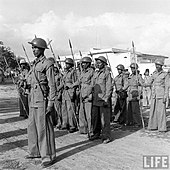
Razakars during Performance Polo

Spears are known every bit Bhala in Indian languages.[39] Spears in the Indian society were used both in missile and non-missile form, both by cavalry and foot-soldiers. Mounted spear-fighting was practiced using with a ten-foot, ball-tipped wooden lance chosen a bothati, the end of which was covered in dye then that hits may be confirmed. Spears were constructed from a variety of materials such as the sang fabricated completely of steel, and the ballam which had a bamboo shaft.
The Arab presence in Sindh and the Mameluks of Delhi introduced the Middle Eastern javelin into India.
The Rajputs wielded a type of spear for infantrymen which had a guild integrated into the spearhead, and a pointed butt end. Other spears had forked blades, several spear-points, and numerous other innovations. 1 particular spear unique to India was the vita or corded lance.
Used by the Maratha army, it had a rope connecting the spear with the user's wrist, assuasive the weapon to be thrown and pulled back. The Vel is a type of spear or lance, originated in Southern India, primarily used past Tamils.[twoscore] [41]
Sikh Nihangs sometimes carry a spear even today. Spears were used in conflicts and training past armed paramilitary units such as the razakars of Nizams of Hyderabad State as late as the second half of the 20th century.
Japan [edit]
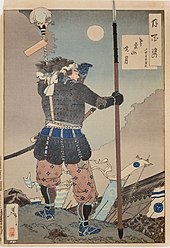
Ukiyo-e impress of a samurai general property a yari in his correct hand
The hoko spear was used in ancient Japan old betwixt the Yayoi period and the Heian menstruation, just information technology became unpopular every bit early on samurai often acted as horseback archers. Medieval Japan employed spears once again for infantrymen to use, but it was not until the 11th century in that samurai began to adopt spears over bows. Several polearms were used in the Japanese theatres; the naginata was a glaive-similar weapon with a long, curved blade popularly among the samurai and the Buddhist warrior-monks, oftentimes used against cavalry; the yari was a longer polearm, with a directly-bladed spearhead, which became the weapon of choice of both the samurai and the ashigaru (footmen) during the Warring States Era; the horseback samurai used shorter yari for his single-armed combat; on the other hand, ashigaru infantries used long yari (similar with European pike) for their massed combat formation.
Philippines [edit]

A Filipino warrior belongings a Sibat (spear) in the Boxer Codex.
Filipino spears (sibat) were used as both a weapon and a tool throughout the Philippines. It is besides called a bangkaw (afterward the Bankaw Defection.), sumbling or palupad in the islands of Visayas and Mindanao. Sibat are typically made from rattan, either with a sharpened tip or a head made from metallic. These heads may either exist single-edged, double-edged or barbed. Styles vary according to function and origin. For example, a sibat designed for fishing may not be the same every bit those used for hunting.
The spear was used as the primary weapon in expeditions and battles against neighbouring island kingdoms and information technology became famous during the 1521 Battle of Mactan, where the chieftain Lapu Lapu of Cebu fought against Spanish forces led by Ferdinand Magellan who was subsequently killed.
Africa [edit]
![[icon]](https://upload.wikimedia.org/wikipedia/commons/thumb/1/1c/Wiki_letter_w_cropped.svg/20px-Wiki_letter_w_cropped.svg.png) | This section needs expansion. You lot can help by adding to it. (Apr 2010) |

The various types of the assegai (a light spear or javelin made of woods and pointed with atomic number 26 or burn down-hardened tip) were used throughout Africa and it was the most common weapon used before the introduction of firearms. The Zulu, Xhosa and other Nguni tribes of Due south Africa were renowned for their use of the assegai.
Shaka of the Zulu invented a shorter stabbing spear with a ii-foot (0.61m) shaft and a larger, broader blade one foot (0.3m) long. This weapon is otherwise known as the iklwa or ixwa, after the sound that was heard every bit it was withdrawn from the victim's wound.[42] [43] The traditional spear was not abandoned, but was used to range attack enemy formations before endmost in for close quarters boxing with the iklwa. This tactical combination originated during Shaka's military reforms. This weapon was typically used with 1 hand while the off paw held a cowhide shield for protection.
The Americas [edit]
W Mexico and South America (Pre-Republic of colombia) [edit]
As avant-garde metallurgy was largely unknown in pre-Columbian America outside of Western Mexico and South America, most weapons in Meso-America were made of wood or obsidian. This did non hateful that they were less lethal, equally obsidian may be sharpened to become many times sharper than steel.[44] Meso-American spears varied profoundly in shape and size. While the Aztecs preferred the sword-similar macuahuitl for fighting,[45] the advantage of a far-reaching thrusting weapon was recognised, and a big portion of the army would carry the tepoztopilli into battle.[46] The tepoztopilli was a pole-arm, and to approximate from depictions in various Aztec codices, it was roughly the pinnacle of a man, with a broad wooden head about twice the length of the users' palm or shorter, edged with razor-sharp obsidian blades which were securely fix in grooves carved into the head, and cemented in place with bitumen or plant resin as an agglutinative. The tepoztopilli was able both to thrust and slash finer.
Throwing spears also were used extensively in Meso-American warfare, usually with the help of an atlatl.[47] Throwing spears were typically shorter and more than stream-lined than the tepoztopilli, and some had obsidian edges for greater penetration.
Native Americans [edit]

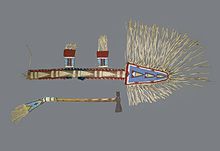
Typically, well-nigh spears fabricated by Native Americans were created with materials surrounded by their communities. Usually, the shaft of the spear was made with a wooden stick while the head of the spear was fashioned from arrowheads, pieces of metal such as copper, or a bone that had been sharpened. Spears were a preferred weapon by many since it was inexpensive to create, could more easily be taught to others, and could exist made quickly and in large quantities.
Native Americans used the buffalo pound method to kill buffalo, which required a hunter to dress as a buffalo and lure 1 into a ravine where other hunters were hiding. In one case the buffalo appeared, the other hunters would impale him with spears. A variation of this technique, called the buffalo jump, was when a runner would lead the animals towards a cliff. As the buffalo got close to the cliff, other members of the tribe would jump out from behind rocks or copse and scare the buffalo over the cliff. Other hunters would be waiting at the lesser of the cliff to spear the animal to death.[48]
Hunting [edit]
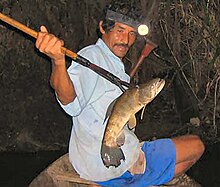
One of the earliest forms of killing prey for humans, hunting game with a spear and spear line-fishing continues to this day every bit both a ways of catching food and equally a cultural activity. Some of the most common prey for early on humans were mega fauna such every bit mammoths which were hunted with various kinds of spear. One theory for the Quaternary extinction effect was that nigh of these animals were hunted to extinction past humans with spears. Even afterwards the invention of other hunting weapons such equally the bow the spear continued to be used, either as a projectile weapon or used in the hand every bit was common in boar hunting.
| | This department needs expansion. You can help by adding to it. (March 2010) |
Types [edit]
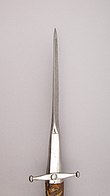
- Barred spears: A barred spear has a crossbar beneath the blade, to prevent too deep a penetration of the spear into an beast. The bar may exist forged as part of the spearhead or may be more loosely tied by ways of loops below the blade. Barred spears are known from the Statuary Age, but the outset historical record of their use in Europe is found in the writings of Xenophon in the fifth century BCE.[49] Examples besides are shown in Roman art. In the Eye Ages, a winged or lugged war-spear was developed (meet above), only the afterward Middle Ages saw the evolution of specialised types, such as the boar-spear and the comport-spear.[50] The boar-spear could be used both on foot or horseback.
- Javelin
- Harpoon
- Trident
Modern revival [edit]
Spear hunting fell out of favour in most of Europe in the 18th century, simply connected in Germany, enjoying a revival in the 1930s.[51] Spear hunting is withal practiced in the Us.[52] Animals taken are primarily wild boar and deer, although trophy animals such as cats and large game as large as a Greatcoat Buffalo are hunted with spears. Alligators are hunted in Florida with a blazon of harpoon.
In myth and legend [edit]
Symbolism [edit]

Like many weapons, a spear may besides be a symbol of power.
The Celts would symbolically destroy a dead warrior's spear either to forbid its utilize by another or as a sacrificial offering.
In classical Greek mythology Zeus' bolts of lightning may be interpreted every bit a symbolic spear. Some would behave that interpretation to the spear that frequently is associated with Athena, interpreting her spear as a symbolic connection to some of Zeus' ability beyond the Custodianship once he rose to replacing other deities in the pantheon. Athena was depicted with a spear prior to that change in myths, however. Chiron'south wedding ceremony-gift to Peleus when he married the nymph Thetis in classical Greek mythology, was an ashen spear equally the nature of ashwood with its directly grain fabricated information technology an ideal selection of woods for a spear.
The Romans and their early on enemies would force prisoners to walk underneath a 'yoke of spears', which humiliated them. The yoke would consist of three spears, two upright with a third tied betwixt them at a height which fabricated the prisoners stoop.[53] It has been suggested that the arrangement has a magical origin, a manner to trap evil spirits.[54] The word subjugate has its origins in this practice (from Latin sub = nether, jugum = yoke).[55]
In Norse mythology, the god Odin's spear (named Gungnir) was made by the sons of Ivaldi. It had the special property that it never missed its marker. During the War with the Vanir, Odin symbolically threw Gungnir into the Vanir host. This exercise of symbolically casting a spear into the enemy ranks at the beginning of a fight was sometimes used in historic clashes, to seek Odin's support in the coming battle.[56] In Wagner'south opera Siegfried, the haft of Gungnir is said to be from the "Globe-Tree" Yggdrasil.[57]
Other spears of religious significance are the Holy Lance[58] and the Lúin of Celtchar,[59] believed by some to have vast mystical powers.
Sir James George Frazer in The Golden Bender [sixty] noted the phallic nature of the spear and suggested that in the Arthurian legends the spear or lance functioned every bit a symbol of male fertility, paired with the Grail (as a symbol of female fertility).

The Hindu god of war Murugan is worshipped by Tamils in the form of the spear chosen Vel, which is his primary weapon.[61]
The term spear is also used (in a somewhat archaic style) to describe the male line of a family, as opposed to the distaff or female line.
[edit]
- Amenonuhoko, spear of Izanagi and Izanami, creator gods in Japanese mythology
- Gáe Bulg, spear of Cúchulainn, hero in Irish mythology
- Gáe Buide and Gáe Derg, spears of Diarmuid Ua Duibhne which could inflict wounds that none tin recover from
- Green Dragon Crescent Bract, a guan dao wielded past Full general Guan Yu in the Romance of the Three Kingdoms
- Gungnir, spear of Odin, a god in Norse mythology
- Holy Lance, said to be the spear that pierced the side of Jesus
- Rhongomyniad referred to only as Ron ("spear") in Geoffrey of Monmouth's History of Britain, the spear of King Arthur.[62] [ verification needed ]
- Ophidian Spear wielded by General Zhang Fei in the Romance of the Iii Kingdoms
- Spear of Fuchai, the spear used by Goujian'south arch-rival, Rex Fuchai of Wu, in Cathay
- Spear of Lugh, named after Lugh, a god in Irish mythology
- Trident, a three-pronged fishing spear associated with a number of water deities, including the Etruscan Nethuns, Greek Poseidon, and Roman Neptune.
- Trishula, a 3-pronged spear wielded by the Hindu deities Durga and Shiva
- Vel, a flattened broad tipped spear used by the Hindu deity Murugan
Come across also [edit]
- List of types of spears
- Viking Age arms and armour
- Projectile
Related weapons:
- Arrow (weapon)
- Assegai
- Atlatl
- Bill (weapon)
- Sprint (missile)
- Glaive
- Halberd
- Javelin
- Kontos (weapon)
- Lance
- Naginata
- Superhighway (weapon)
- Pilum
- Pole weapon
- Spear thrower
- Woomera (spear-thrower)
- Xyston
Notes and references [edit]
- ^ Weir, William. 50 Weapons That Changed Warfare. The Career Press, 2005, p 12.
- ^ Pruetz, Jill D.; Bertolani, Paco (2007). "Savanna Chimpanzees, Pan troglodytes verus, Hunt with Tools". Current Biological science. 17 (5): 412–417. doi:ten.1016/j.cub.2006.12.042. PMID 17320393. S2CID 16551874.
- ^ Thieme, Hartmut (1997-02-27). "Lower Palaeolithic hunting spears from Germany". Nature. 385 (6619): 807–810. Bibcode:1997Natur.385..807T. doi:x.1038/385807a0. PMID 9039910. S2CID 4283393. Retrieved 2017-01-09 .
- ^ Monte Morin, "Rock-tipped spear may accept much earlier origin", Los Angeles Times, November 16, 2012
- ^ J. Wilkins et al. "Testify for early on hafted hunting applied science". Science, Vol. 338, Nov. sixteen, 2012, p. 942. doi:10.1126/science.1227608.
- ^ Rick Weiss, "Chimps Observed Making Their Own Weapons", The Washington Post, Feb 22, 2007
- ^ Wymer, John (1982). The Palaeolithic Age. London: Croom Helm. p. 192. ISBN978-0-7099-2710-5.
- ^ Webster, T.B.L. (1977). From Mycenae to Homer. London: Methuen. pp. 166–8. ISBN978-0-416-70570-vi . Retrieved fifteen Feb 2010.
- ^ Hanson, Victor Davis (1999). "Chapter 2 : The Rise of the Urban center Land and the Invention of Western Warfare". The Wars of the Ancient Greeks. London: Cassell. pp. 42–83. ISBN978-0-304-35982-0.
- ^ Hanson (1999), p. 59
- ^ Hanson (1999), pp.147–eight
- ^ Hanson (1999), pp149-150
- ^ Hunt, Peter. The Cambridge History of Greek and Roman Warfare: Volume ane, Hellenic republic, The Hellenistic Earth and the Rise of Rome. Cambridge University Press, 2007, p. 108
- ^ Bishop, Thousand.C.; Coulston J.C. (1989). Roman Military Equipment. Princes Risborough: Shire Publications. ISBN978-0-7478-0005-7.
- ^ "Viking Spear". Hurstwic.org . Retrieved 2017-01-09 .
- ^ Swanton, M.J. (1973). The Spearheads of the Anglo-Saxon Settlement. London: Regal Archaeological Institute.
- ^ Martin, Paul (1968). Armour and weapons. London: Herbert Jenkins. p. 226.
- ^ e.g. at the Battle of Steppes, 1213. Oman, Sir Charles (1991) [1924]. The Art of War in the Middle Ages. Vol. 1. London: Greenhill Books. p. 451. ISBN978-1-85367-100-5.
- ^ Fisher, Andrew (1986). William Wallace. Edinburgh: John Donald. p. eighty. ISBN978-0-85976-154-iii.
- ^ Verbruggen, J. F. (1997). The Fine art of Warfare in Western Europe in the Middle Ages (2nd. ed.). Woodbridge: Boydell Press. pp. 184–5. ISBN978-0-85115-630-9.
- ^ Scott, Ronald McNair (1988). Robert the Bruce, King of Scots. New York: Peter Bedrick Books. pp. 148, 158–159, 202–203.
- ^ Morris, Paul (September 2000). "'We take met Devils!': The Almogavars of James I and Peter III of Catalonia–Aragon". Anistoriton. 004 . Retrieved 2009-08-04 .
- ^ Heath, Ian (1993). The Irish Wars 1485–1603. Oxford: Osprey. p. 36. ISBN978-1-85532-280-6.
- ^ Arnold, Thomas (2001). The Renaissance at State of war. London: Cassel & Co. pp. lx–72. ISBN978-0-304-35270-8.
- ^ Nicholson, Helen (2004). Medieval Warfare. Basingstoke: Palgrave MacMillan. pp. 102–3. ISBN978-0-333-76331-v.
- ^ * Sébastien Nadot, Rompez les lances ! Chevaliers et tournois au Moyen Age, Paris, ed. Autrement, 2010. (Couch your lances ! Knights and tournaments in the Heart Ages...)
- ^ Nicholson (2004), p. 102
- ^ Nicholson (2004), p101
- ^ Arnold (2001), pp.66–72, 78–81
- ^ Arnold (2001), pp.92–100
- ^ Oakeshott, Ewart (1980). European Weapons and Armour. Guildford & London: Lutterworth Printing. p. 56. ISBN978-0-7188-2126-5.
- ^ Oakeshott (1980), p.55
- ^ Oakeshott (1980), p.56
- ^ "Spear Training | Spear Fighting | 枪 矛 厹". Purple Gainsay Arts.
- ^ 郑, 轶伟 (2007). 中国古代冷兵器. 上海: 上海文化出版社. p. 19. ISBN978-seven-80740-220-6.
- ^ 郑, 轶伟 (2007). 中国古代冷兵器. 上海: 上海文化出版社. p. 20. ISBN978-7-80740-220-6.
- ^ 郑, 轶伟 (2007). 中国古代冷兵器. 上海: 上海文化出版社. p. 21. ISBN978-seven-80740-220-6.
- ^ 郑, 轶伟 (2007). 中国古代冷兵器. 上海: 上海文化出版社. p. 22. ISBN978-7-80740-220-6.
- ^ Pant, Gayatri Nath (1970). Studies in Indian Weapons and Warfare. Regular army Educational Stores. pp. 158. 281. Retrieved fourteen August 2021.
- ^ Nikkilä, Pertti (1997). StO. Finnish Oriental Guild. ISBN9789519380315.
- ^ Subrahmanian, North. (1996). Śaṅgam polity: the administration and social life of the Śaṅgam Tamils. Ennes.
- ^ "TherionArms – Zulu 'Iklwa' war spear". world wide web.therionarms.com.
- ^ McBride, Angus (1976). The Zulu War . Osprey Publishing. pp. 9. ISBN9780850452563.
- ^ Cadet, BA (March 1982). "Aboriginal technology in gimmicky surgery". The Western Journal of Medicine. 136 (three): 265–269. ISSN 0093-0415. OCLC 115633208. PMC1273673. PMID 7046256.
- ^ "Archived copy". www.precolumbianweapons.com. Archived from the original on iv February 2008. Retrieved 17 January 2022.
{{cite web}}: CS1 maint: archived re-create as championship (link) - ^ "Precolumbian Spears". Feb iv, 2008. Archived from the original on 2008-02-04.
- ^ "Archived copy". www.precolumbianweapons.com. Archived from the original on iv February 2008. Retrieved 17 January 2022.
{{cite web}}: CS1 maint: archived copy every bit title (link) - ^ "Native American Spears". Indians.org . Retrieved 22 July 2014.
- ^ Blackmore, Howard (2003). Hunting Weapons from the Eye Ages to the Twentieth Century. Dover. pp. 83–four. ISBN978-0-486-40961-0 . Retrieved 1 March 2010.
- ^ Blackmore (2003), pp.88–91
- ^ Blackmore (2003), pp92-3.
- ^ "Spear Hunting Museum > Home".
- ^ Connolly, Peter (1981). Greece and Rome at State of war. London: Macdonald Phoebus. p. 89. ISBN978-0-356-06798-8.
- ^ Chiliad. Cary and A. D. Nock. "Magic Spears". The Classical Quarterly, Vol. 21, No. iii/4 (June–October 1927), pp. 122–127
- ^ "subjugation". Online Etymology Dictionary . Retrieved 2017-01-09 .
- ^ Crossley-Holland, Kevin (1982). The Norse Myths. London: Penguin. pp. 51, 197. ISBN978-0-14-006056-0.
- ^ "Score: BHR0215". Dlib.indiana.edu . Retrieved 2017-01-09 .
- ^ E. A. Livingstone, ed. (2006). Concise Oxford Dictionary of the Christian Church. Oxford Reference. ISBN978-0-19-861442-five . Retrieved 2017-01-09 .
- ^ James MacKillop, author (January 2004). Lexicon of Celtic Mythology. Oxford Reference. ISBN978-0-xix-860967-4 . Retrieved 2017-01-09 .
- ^ "The Golden Bough" – via Project Gutenberg.
- ^ Clothey, Fred W. (1978). The Many Faces of Murukan̲: The History and Pregnant of a South Indian God. Walter de Gruyter. ISBN9789027976321.
- ^ P. 1000. Ford, "On the Significance of some Arthurian Names in Welsh", in Bulletin of the Board of Celtic Studies xxx (1983), pp.268–273 at p.71; R. Bromwich and D. Simon Evans, Culhwch and Olwen. An Edition and Report of the Oldest Arthurian Tale (Cardiff: University of Wales Press, 1992), p.64
 | Wikimedia Commons has media related to Spears. |
 | Wikiquote has quotations related to: Spear |
Source: https://en.wikipedia.org/wiki/Spear
0 Response to "Pike a W Et Al ââåuseries Dating of Paleolithic Art in 11 Caves in Spainã¢ââ"
Post a Comment