what was the importance of ghana to the gold and salt trade?
Common salt from the Sahara desert was one of the major trade goods of ancient West Africa where very fiddling naturally occurring deposits of the mineral could be found. Transported via camel caravans and past boat along such rivers as the Niger and Senegal, common salt found its way to trading centres similar Koumbi Saleh, Niani, and Timbuktu, where it was either passed farther due south or exchanged for other goods such as ivory, hides, copper, fe, and cereals. The most common exchange was salt for gilded dust that came from the mines of southern W Africa. Indeed, salt was such a precious article that it was quite literally worth its weight in gold in some parts of West Africa.
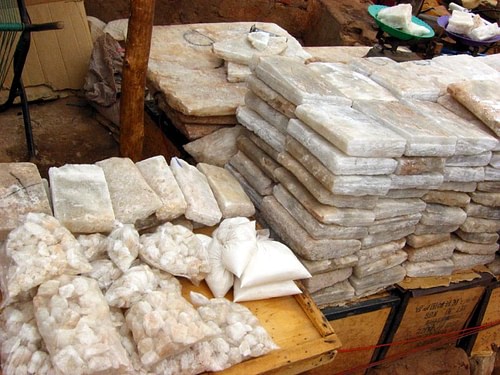
Salt Slabs, Timbuktu
The Common salt Mines of the Sahara
The necessity for salt in ancient Due west Africa is here summarised in an extract from the UNESCO General History of Africa:
Table salt is a mineral that was in great need particularly with the beginning of an agricultural way of life. Hunters and food-gatherers probably obtained a big amount of their common salt intake from the animals they hunted and from fresh establish food. Salt only becomes an essential additive where fresh foods are unobtainable in vey dry areas, where body perspiration is besides normally excessive. It becomes extremely desirable, however, amongst societies with relatively restricted diets, as was the case with arable agriculturalists. (Vol II, 384-v)
In add-on, common salt was always in great demand in order to improve preserve dried meat and to give added taste to food. The savannah region south of the western Sahara desert (known equally the Sudan region) and the forests of southern Westward Africa were poor in salt. Those areas near the Atlantic coast could obtain the mineral from evaporation pans or humid bounding main water, merely body of water salt did non travel or proceed well. A third alternative was common salt derived from the ashes of burnt plants like millet and palms, merely over again these were non so rich in sodium chloride. Consequently, for nigh of the Sudan region, salt had to come up from the due north. The inhospitable Sahara desert was the principal natural source of rock salt, either acquired from surface deposits caused by the desiccation procedure such as constitute in old lake beds or extracted from relatively shallow mines where the salt is naturally formed into slabs. This common salt, which was a creamy-greyness colour, was far superior to the other sources of table salt from the bounding main or certain plants.
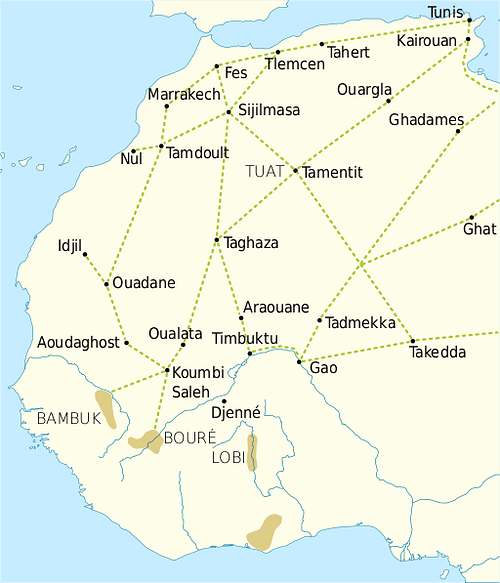
Trans-Saharan Trade Routes
When exactly table salt became a trade commodity is unknown, merely the exchange of salt for cereals dates back to prehistory when desert and savannah peoples each looked to proceeds what they could non produce themselves. On a larger scale, camel caravans were likely crossing the Sahara from at least the first centuries of the 1st millennium CE. These caravans would be run by the Berbers who acted every bit middle-men betwixt the North African states and West Africa. Salt was their major trade good but they likewise brought luxury items like glassware, fine textile, and manufactured goods. In improver, with these trade goods came the Islamic religion, ideas in art and architecture, and cultural practices.
Whoever controlled the table salt trade also controlled the gilded merchandise, & both were the principal economic pillars of diverse West African empires.
Table salt, both its production and merchandise, would boss West African economies throughout the 2nd millennium CE, with sources and trade centres constantly changing hands as empires rose and fell. The salt mines of Idjil in the Sahara were a famous source of the precious article for the Ghana Empire (half dozen-13th century CE) and were still going strong in the 15th century CE. In the 10th century CE the Sanhaja Berbers, who controlled the common salt mines at Awlil and Taghaza and transportation through trade cities like Audaghost, began to challenge the Republic of ghana Empire'southward monopoly of the trade. In the 11th century CE the Awlil mines were in the easily of Takrur, but it would exist the Mali Empire (1240-1645 CE), with its capital at Niani, that dominated the sub-Saharan salt merchandise following the plummet of the Ghana Empire. However, semi-contained river 'ports' similar Timbuktu began to steal trade opportunities from the Mali kings further west. The next kingdom to dominate the region and the movement of table salt was the Songhai Empire (15-16th century CE) with its smashing trading capital at Gao.
Salt may take been a rarity in the savannah but at desert mining towns similar Taghaza (the principal Sudan source of salt up to the 16th century CE) and Taoudenni, the commodity was still then arable slabs of rock table salt were used to build homes. Naturally, such a valuable money-spinner equally a common salt mine attracted competition for ownership, as when the Moroccan leader Muhammad al-Mahdi attempted to musculus in on the market by arranging for several prominent Tuareg common salt traders to be murdered at Taghaza in the mid-16th century CE. Quite literally, whoever controlled the common salt trade also controlled the gold trade, and both were the principal economic pillars of the various empires of West Africa's history.
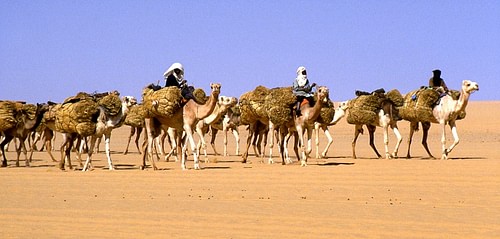
Trans-Saharan Camel Caravan
The 14th-century CE Muslim traveller Ibn Battuta, who visited West Africa c. 1352 CE, gives a lengthy clarification of life in the salt mine settlement of Taoudenni:
Information technology is a hamlet with no attractions. A strange thing about it is that its houses and mosques are built of blocks of table salt and roofed with camel skins. At that place are no trees, only sand in which at that place is a salt mine. They dig the footing and thick slabs are found in information technology, lying on each other as if they had been cut and stacked under the ground. A camel carries two slabs. The only people living in that location are the slaves of the Massufa, who dig for the salt.
(quoted in de Villiers, 121-122)
Transportation
The salt slabs, relatively durable merely unwieldy, were loaded onto camels, each animal conveying two blocks that weighed up to 90 kilos (200 lbs) each. A camel caravan could be equanimous of anywhere from 500 to several thousands of camels in their heyday. The outset caravans likely crossed the western Sahara in the tertiary century CE, if non earlier, but the practice really took off from the 9th to 12th century CE. When the caravans arrived at a trading centre or major settlement in the Sudan region, the salt was exchanged for goods to carry back across the desert on the return journey; typically such loads included gold, leather, animal skins, and ivory. The salt could be used in the communities around the trading centres or simply transported on by boat along such rivers as the Niger, the Senegal, and their tributaries. Finally, the salt was cut up into smaller pieces and porters carried it on their heads to its final destination - the villages of West Africa'south interior.
Worth its Weight in Gold
Salt was a highly valued commodity non only considering information technology was unobtainable in the sub-Saharan region but because it was constantly consumed and supply never quite met the total demand. There was also the trouble that such a bulky item cost more than to transport in significant quantities, which only added to its loftier cost. Consequently, salt was very often exchanged for aureate grit, sometimes even pound for pound in remote areas, with merchants specialising in i of the commodities. Indeed, such was the stability of the mineral's value, in some rural areas small-scale pieces of salt were used as a currency in trade transactions and the kings of Ghana kept stockpiles of salt aslope the gold nuggets that filled their impressive royal treasury. The passage of such a valuable item from one trader to some other provided aplenty opportunity to increment its value the further information technology went from its source in the Sahara.
An anonymous Arab traveller of the 10th century CE recorded the delicate operation of bulk trading between salt and gold merchants, sometimes chosen 'the silent trade' where neither party actually met face to face:
Great people of the Sudan lived in Ghana. They had traced a boundary which no i who sets out to them ever crosses. When the merchants accomplish this purlieus, they identify their wares and cloth on the basis and then depart, and so the people of the Sudan come up bearing gilded which they leave beside the trade and and then depart. The owners of the merchandise then return, and if they were satisfied with what they had found, they take it. If not, they go away again, and the people of the Sudan return and add to the toll until the bargain is ended.
(quoted in Spielvogel, 229)
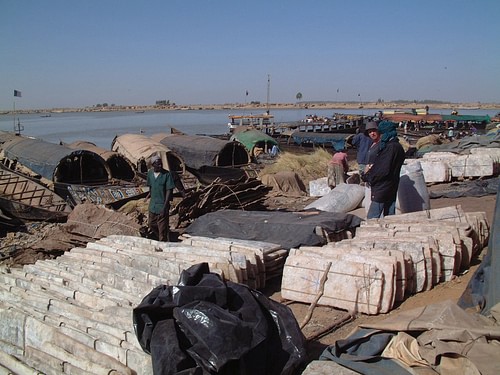
Transporting Salt on the Niger River
Even the passage through of salt could exist a lucrative source of income for rulers. For example, the Arab traveller Al-Bakri, visiting the Sudan region in 1076 CE, describes the duties on table salt in the Ghana Empire which were, different with other appurtenances like copper, taxed twice: "On every donkey-load of salt the King of Ghana levys one golden dinar when information technology is brought into his country and two dinars when information technology is sent out" (quoted in Fage, 670). In another example, Timbuktu operated as the eye-trader in this substitution of northern and W African resources. A 90-kilo block of salt, transported by river from Timbuktu to Djenne (aka Jenne) in the south could double its value and be worth around 450 grams of gold. As the Tarikh al-Sudan chronicle, compiled c. 1656 CE, notes:
Jenne is one of the greatest Muslim markets, where traders carrying salt from the mines of Taghaza run across traders with the gilded of Bitou…It is because of this blessed town that caravans come to Timbuktu from all points of the horizon.
(quoted in Oliver, 374)
Even today, the salt trade continues, although the deposits are running out and the salt merchants can no longer command golden dust in substitution. Saharan salt from Taoudenni is however transported by Tuareg camel caravans, the all the same-90-kilo slabs now ultimately destined for the refineries of Bamako in Mali.
This article has been reviewed for accuracy, reliability and adherence to academic standards prior to publication.
Source: https://www.worldhistory.org/article/1342/the-salt-trade-of-ancient-west-africa/
0 Response to "what was the importance of ghana to the gold and salt trade?"
Post a Comment