What Two Things Do You Need to Know to Describe the Velocity of an Object?
| Velocity | |
|---|---|
 Every bit a change of direction occurs while the racing cars plough on the curved runway, their velocity is not constant. | |
| Common symbols | v , five , v → |
| Other units | mph, ft/southward |
| In SI base of operations units | m/due south |
| Dimension | L T −1 |
The velocity of an object is the rate of change of its position with respect to a frame of reference, and is a function of time. Velocity is equivalent to a specification of an object's speed and direction of motion (eastward.thousand. 60 km/h to the north). Velocity is a fundamental concept in kinematics, the co-operative of classical mechanics that describes the motility of bodies.
Velocity is a physical vector quantity; both magnitude and direction are needed to ascertain information technology. The scalar absolute value (magnitude) of velocity is chosen speed, beingness a coherent derived unit of measurement whose quantity is measured in the SI (metric arrangement) as metres per 2d (1000/s or 1000⋅s−1). For example, "5 metres per second" is a scalar, whereas "5 metres per second east" is a vector. If in that location is a change in speed, direction or both, then the object is said to be undergoing an acceleration.
Abiding velocity vs dispatch
To have a constant velocity, an object must have a abiding speed in a constant management. Abiding direction constrains the object to movement in a straight path thus, a constant velocity means motility in a straight line at a constant speed.
For example, a automobile moving at a constant twenty kilometres per hour in a circular path has a constant speed, simply does not have a constant velocity considering its management changes. Hence, the car is considered to be undergoing an dispatch.
Deviation betwixt speed and velocity
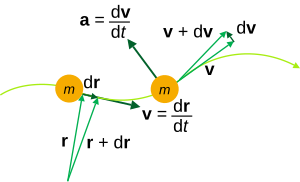
Kinematic quantities of a classical particle: mass m, position r, velocity 5, acceleration a.
Speed, the scalar magnitude of a velocity vector, denotes only how fast an object is moving.[1] [2]
Equation of motility
Boilerplate velocity
Velocity is defined as the rate of change of position with respect to time, which may besides exist referred to equally the instantaneous velocity to emphasize the stardom from the average velocity. In some applications the average velocity of an object might be needed, that is to say, the constant velocity that would provide the same resultant displacement as a variable velocity in the same time interval, v (t), over some time period Δt . Boilerplate velocity can be calculated equally:

The average velocity is always less than or equal to the average speed of an object. This tin exist seen by realizing that while distance is ever strictly increasing, displacement tin can increase or decrease in magnitude besides as alter direction.
In terms of a displacement-time (10 vs. t) graph, the instantaneous velocity (or, simply, velocity) tin can be thought of as the gradient of the tangent line to the curve at whatever point, and the boilerplate velocity as the gradient of the secant line between two points with t coordinates equal to the boundaries of the time catamenia for the average velocity.
The boilerplate velocity is the same as the velocity averaged over time – that is to say, its fourth dimension-weighted boilerplate, which may be calculated as the time integral of the velocity:
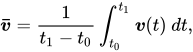
where we may place
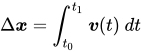
and

Instantaneous velocity
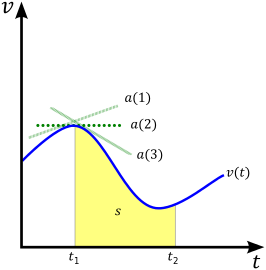
Instance of a velocity vs. fourth dimension graph, and the relationship between velocity v on the y-centrality, dispatch a (the 3 green tangent lines stand for the values for dispatch at different points along the curve) and displacement south (the yellow expanse under the curve.)
If we consider v as velocity and x as the deportation (modify in position) vector, then we tin limited the (instantaneous) velocity of a particle or object, at whatever particular time t , as the derivative of the position with respect to time:
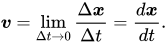
From this derivative equation, in the one-dimensional case it can be seen that the expanse under a velocity vs. time ( v vs. t graph) is the displacement, x . In calculus terms, the integral of the velocity function v (t) is the deportation role x (t). In the figure, this corresponds to the yellow area nether the curve labeled south ( southward being an alternative notation for displacement).

Since the derivative of the position with respect to time gives the alter in position (in metres) divided by the change in time (in seconds), velocity is measured in metres per second (g/south). Although the concept of an instantaneous velocity might at beginning seem counter-intuitive, information technology may be thought of every bit the velocity that the object would continue to travel at if it stopped accelerating at that moment.
Relationship to acceleration
Although velocity is defined as the rate of change of position, it is ofttimes mutual to start with an expression for an object's dispatch. Equally seen by the three greenish tangent lines in the figure, an object's instantaneous acceleration at a point in time is the gradient of the line tangent to the bend of a v (t) graph at that indicate. In other words, acceleration is defined as the derivative of velocity with respect to time:

From there, nosotros can obtain an expression for velocity equally the area nether an a (t) acceleration vs. time graph. As above, this is done using the concept of the integral:

Constant acceleration
In the special example of abiding acceleration, velocity tin be studied using the suvat equations. By considering a as existence equal to some capricious constant vector, it is trivial to show that

with v equally the velocity at time t and u equally the velocity at time t = 0. Past combining this equation with the suvat equation x = ut + at 2/2, it is possible to chronicle the displacement and the average velocity past
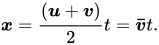
It is too possible to derive an expression for the velocity independent of time, known as the Torricelli equation, as follows:



where v = | v | etc.
The to a higher place equations are valid for both Newtonian mechanics and special relativity. Where Newtonian mechanics and special relativity differ is in how different observers would depict the same situation. In particular, in Newtonian mechanics, all observers concur on the value of t and the transformation rules for position create a state of affairs in which all non-accelerating observers would depict the dispatch of an object with the same values. Neither is true for special relativity. In other words, only relative velocity can exist calculated.
Quantities that are dependent on velocity
The kinetic free energy of a moving object is dependent on its velocity and is given by the equation

ignoring special relativity, where Due east k is the kinetic energy and m is the mass. Kinetic free energy is a scalar quantity every bit it depends on the square of the velocity, however a related quantity, momentum, is a vector and defined past

In special relativity, the dimensionless Lorentz factor appears often, and is given by
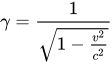
where γ is the Lorentz factor and c is the speed of light.
Escape velocity is the minimum speed a ballistic object needs to escape from a massive body such as Earth. It represents the kinetic energy that, when added to the object's gravitational potential energy, (which is always negative) is equal to zilch. The general formula for the escape velocity of an object at a distance r from the center of a planet with mass M is
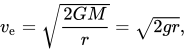
where G is the Gravitational constant and one thousand is the Gravitational acceleration. The escape velocity from World'due south surface is most 11 200 grand/s, and is irrespective of the direction of the object. This makes "escape velocity" somewhat of a misnomer, every bit the more correct term would exist "escape speed": any object attaining a velocity of that magnitude, irrespective of atmosphere, volition leave the vicinity of the base torso as long as it doesn't intersect with something in its path.
Relative velocity
Relative velocity is a measurement of velocity between two objects as determined in a single coordinate organization. Relative velocity is fundamental in both classical and modern physics, since many systems in physics deal with the relative movement of ii or more particles. In Newtonian mechanics, the relative velocity is independent of the chosen inertial reference frame. This is not the case anymore with special relativity in which velocities depend on the option of reference frame.
If an object A is moving with velocity vector v and an object B with velocity vector due west , then the velocity of object A relative to object B is defined as the difference of the two velocity vectors:

Similarly, the relative velocity of object B moving with velocity w , relative to object A moving with velocity five is:

Usually, the inertial frame called is that in which the latter of the 2 mentioned objects is in balance.
Scalar velocities
In the one-dimensional example,[3] the velocities are scalars and the equation is either:
- , if the two objects are moving in opposite directions, or:
- , if the two objects are moving in the same direction.


Polar coordinates

Representation of radial and tangential components of velocity at unlike moments of linear move with constant velocity of the object effectually an observer O (information technology corresponds, for example, to the passage of a car on a straight street around a pedestrian standing on the sidewalk). The radial component tin exist observed due to the Doppler effect, the tangential component causes visible changes of the position of the object.
In polar coordinates, a two-dimensional velocity is described by a radial velocity, divers equally the component of velocity away from or toward the origin (also known as velocity made good), and an athwart velocity, which is the rate of rotation well-nigh the origin (with positive quantities representing counter-clockwise rotation and negative quantities representing clockwise rotation, in a correct-handed coordinate system).
The radial and angular velocities tin can be derived from the Cartesian velocity and displacement vectors past decomposing the velocity vector into radial and transverse components. The transverse velocity is the component of velocity along a circumvolve centered at the origin.

where
The magnitude of the radial velocity is the dot production of the velocity vector and the unit vector in the management of the displacement.

where is displacement.

The magnitude of the transverse velocity is that of the cantankerous product of the unit vector in the management of the displacement and the velocity vector. Information technology is likewise the product of the angular speed and the magnitude of the displacement.

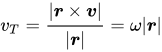
such that
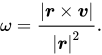
Angular momentum in scalar form is the mass times the distance to the origin times the transverse velocity, or equivalently, the mass times the distance squared times the angular speed. The sign convention for angular momentum is the same as that for angular velocity.

where
The expression is known as moment of inertia. If forces are in the radial direction simply with an inverse square dependence, as in the case of a gravitational orbit, angular momentum is abiding, and transverse speed is inversely proportional to the altitude, athwart speed is inversely proportional to the distance squared, and the rate at which area is swept out is abiding. These relations are known equally Kepler's laws of planetary motion.

See also
- Four-velocity (relativistic version of velocity for Minkowski spacetime)
- Group velocity
- Hypervelocity
- Phase velocity
- Proper velocity (in relativity, using traveler time instead of observer time)
- Rapidity (a version of velocity additive at relativistic speeds)
- Terminal velocity
- Velocity vs. time graph
Notes
- ^ Rowland, Todd (2019). "Velocity Vector". Wolfram MathWorld. Retrieved 2 June 2019.
- ^ Wilson, Edwin Bidwell (1901). Vector assay: a text-book for the use of students of mathematics and physics, founded upon the lectures of J. Willard Gibbs. Yale bicentennial publications. C. Scribner's Sons. p. 125. hdl:2027/mdp.39015000962285. Primeval occurrence of the speed/velocity terminology.
- ^ Basic principle
References
- Robert Resnick and Jearl Walker, Fundamentals of Physics, Wiley; 7 Sub edition (June 16, 2004). ISBN 0-471-23231-9.
External links
 | Wikimedia Commons has media related to Velocity. |
- Velocity and Acceleration
- Introduction to Mechanisms (Carnegie Mellon University)
Source: https://en.wikipedia.org/wiki/Velocity
0 Response to "What Two Things Do You Need to Know to Describe the Velocity of an Object?"
Post a Comment